Most people assume that live event audio production is about mixing. And…yes, that’s absolutely the goal. You show up, dial in a great sound, and run the show. The reality, especially in corporate event audio production, is a little more complicated.
Most of the time, we’re not mixing. We’re fixing.
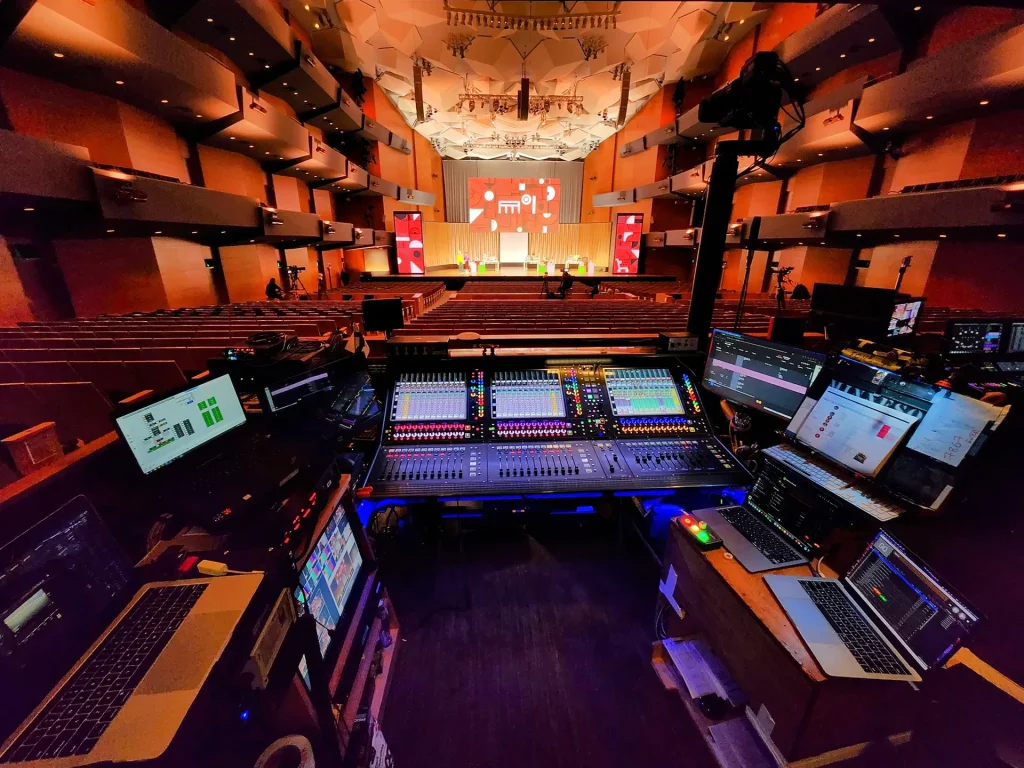
Not in the sense that something is broken, but in the sense that very few environments are ever truly ideal. The room wasn’t designed for speech. The PA can’t go where it should because there’s a video wall or chandelier in the way. The front of house ends up in a corner instead of the center. Presenters speak too quietly, or too loudly, or somewhere in between with no warning.
So instead of starting from a perfect system and shaping a mix, we’re working around constraints and constantly adjusting, compensating, and solving in real time to make everything feel seamless. That’s the part of live event audio most people don’t see. And the part of live event audio we’d rather them not have to think about.
When Constraints Stack
In a perfect world, audio engineers would have ideal speaker placement, predictable acoustics, and consistent input from every presenter. In the real world, compromises are everywhere. And those compromises stack quickly. A slightly off speaker position leads to more gain before feedback concerns, a less-than-ideal console setup limits flexibility. None of these things on their own break a show, but together they change the entire approach.
And that’s when you’ve really got to know what you’re doing. You’re no longer just mixing. You’re fixing the room, the system, and sometimes even the workflow and making small decisions that add up to a result the audience experiences as clear, natural, and effortless.
Anyone can mix in a controlled environment. But in high-pressure productions, the real value of a seasoned audio engineer for corporate events is in how they handle everything that isn’t ideal. It’s knowing what to prioritize, what to leave alone, and how to make adjustments without introducing new problems. It’s understanding how to work with the room instead of fighting it, and how to make the right call quickly when something changes mid-show. Because something always changes…
What Clients Actually Remember
Interestingly, even when things don’t sound exactly the way we might want in a perfect, controlled scenario, that’s not what clients remember. What they remember is whether the show ran smoothly, whether rehearsals stayed on track, and whether anything became a visible problem. If the answer to that last one is no, confidence builds quickly. That’s the real goal of reliable live event audio.
It’s not perfection. It’s consistency, control, and creating an environment where the production team can focus on the event itself instead of worrying about what might go wrong.
Tools Help. Experience Decides.
Of course, tools are getting better. There are new ways to manage room challenges, increase gain before feedback, and clean up signals in ways that weren’t possible even a few years ago. Those tools absolutely help, and they’re becoming part of modern workflows.
But they don’t replace experience.
Because knowing when to use a tool, when to leave something alone, and how to manage the human side of a production. That’s what actually keeps a show moving. You can make something louder with the right tools, but that doesn’t mean you’re making it better.
At the end of the day, great event audio production isn’t just about how something sounds in isolation. It’s about how the room feels and how confident the team is in the people handling it.
And most of the time, that comes down to a simple truth: We’re not mixing, we’re fixing.