
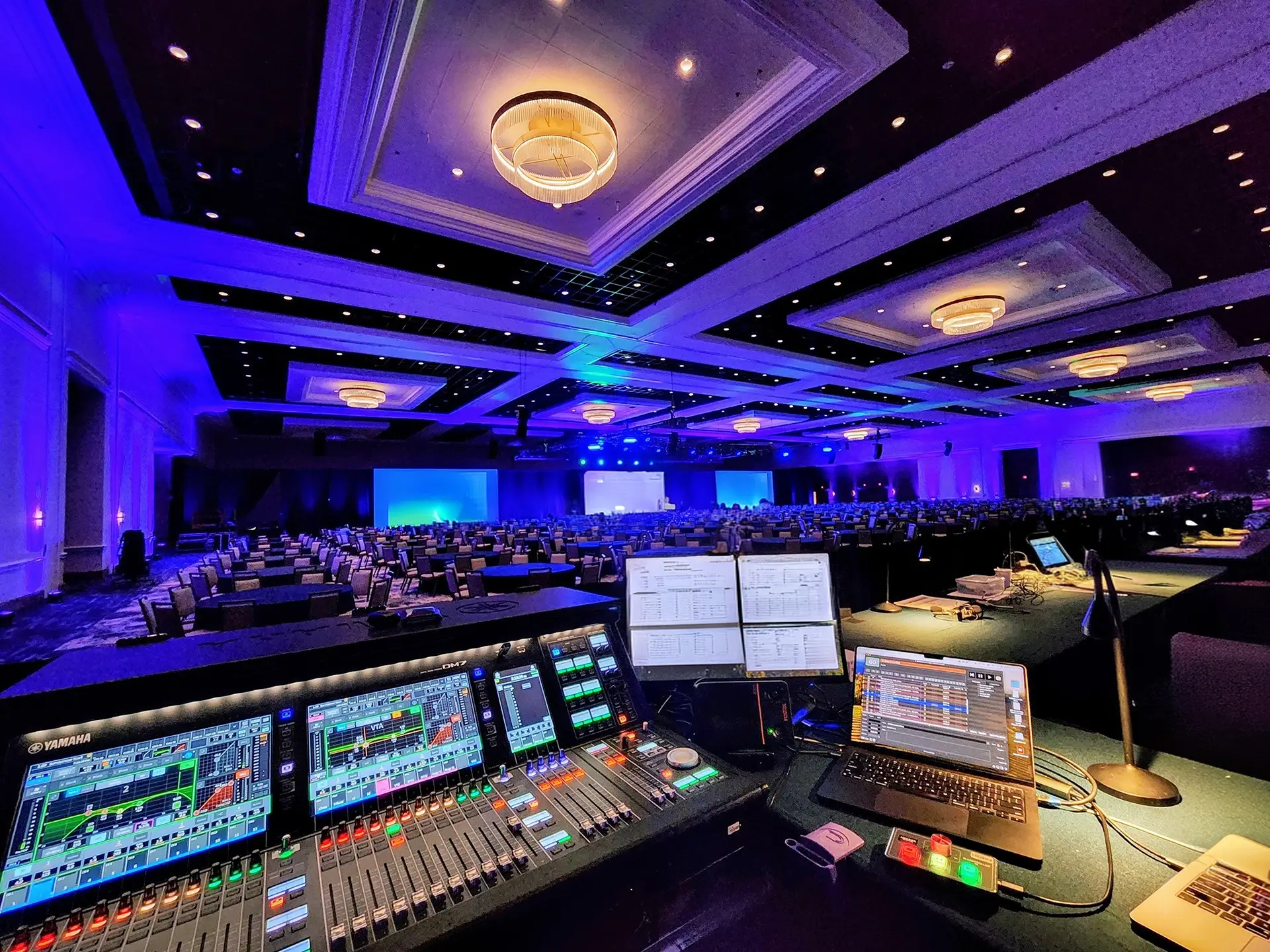
If you’ve been around live events long enough, you’ve probably heard (or said) some version of this: “We just need an operator.” On paper, it sounds reasonable. There’s a console in the room, microphones on stage, and a show to run. You bring in someone to push the faders, keep levels in check, and get you through the day.
But in high-stakes corporate events, that assumption tends to fall apart pretty quickly.
Not because operators aren’t capable, but because the job itself is often misunderstood. What looks like a simple role on the surface is usually carrying far more responsibility than it’s given credit for, especially once the show starts and things inevitably begin to shift.
At that level, audio isn’t just about running equipment…it’s about owning the outcome.
There’s a big difference between someone who shows up to operate a console and someone who is thinking about the entire system and how the room is going to behave once it fills up, how the PA placement is going to affect clarity, how a quiet presenter might struggle to cut through, or how a last-minute change could ripple across the entire setup. In most corporate environments, you’re not starting from perfect conditions. You’re working around constraints, making adjustments in real time, and trying to make all of it feel intentional.
Most of the time, you’re not just shaping sound. You’re dealing with a room that wasn’t designed for speech, a speaker placement that had to accommodate video and lighting, and a mix position that may not even be in a usable spot. You’re making compromises constantly, and the job becomes figuring out how to make those compromises invisible to the audience.
That’s not something you can approach passively. It requires someone who understands the full picture and is prepared to make decisions quickly, often in collaboration with production, and often without the luxury of a second chance. When a microphone drops out, when a presenter changes how they speak, when something in the system doesn’t behave the way it should, the question isn’t just what happened. It’s what do we do next, and how do we keep the show moving without anyone noticing the adjustment.
That level of awareness doesn’t come from simply knowing how to run a console.
And it becomes even more important when you consider that the room is only part of the show. Most corporate events today are also being streamed, recorded, or distributed in some way, which means you’re not just mixing for one environment. You’re balancing multiple outputs at once, each with its own needs, and each with its own potential points of failure. What sounds fine in the room can fall apart online if it hasn’t been thought through ahead of time.
That’s how you end up with the classic situation: everything felt fine in the ballroom, but the stream told a different story. And by the time you realize it, the moment has already passed.
When audio is treated as something that can be handled in the moment, instead of something that needs to be planned and owned, the entire production becomes reactive. More time gets spent troubleshooting during rehearsals, more decisions get made under pressure, and more attention gets pulled away from the actual show.
There’s something that gets lost when every show is treated as a one-off. Context.
The way a particular executive uses a microphone, the way a client structures their panels, the small adjustments that made a difference at the last event. These are all things that don’t live on a gear list. They live with the people who have been there before. When that knowledge carries forward, shows get smoother, transitions get easier, and the entire experience becomes more predictable. Without it, you’re starting from zero every time.
Which is why, in high-stakes environments, the real value isn’t just in having someone who can run the system. It’s in having someone who understands how to design, adapt, and take responsibility for it from start to finish. Because at the end of the day, the cost of getting audio wrong isn’t just technical.
It shows up as stress for the production team, distractions for the audience, and a loss of confidence from the people in the room. And those are the moments people remember, even if they can’t always explain why.
The alternative isn’t adding more complexity. It’s shifting the mindset from staffing a role to trusting a team.
A team that comes in prepared, anticipates what’s coming, and knows how to handle what isn’t. A team that understands when to fix, when to leave things alone, and how to make decisions that keep the show moving. Because in environments where everything matters, audio can’t just be something that gets handled. It has to be something that’s owned.